Leaderboard


Popular Content
Showing content with the highest reputation on 01/07/2018 in all areas
-
Hooky i also have a Navman fish 4430 fishfinder never been used needs transducer yours if you want it2 points
-

A new project named Blah ( could get messy)
Jim and one other reacted to Maverick Martin for a topic
So as I can work out, original Hobbit a total right off new Hobbit is a wreck or at least needs lots of work? if so good luck with the new project and I hope it's not long before you're out there giving us your catch reports2 points -
Hi hooky i have some rods and reels you are welcome too it may help and all the best with everything graham2 points
-
A new project named Blah ( could get messy)
Jim and one other reacted to Maverick Martin for a topic
Thread not moved and can be found Here Would you like them merged ?2 points -
One of the greatest things about kayaking is that it can be remarkably safe and user-friendly activity. But it's important to understand that when things do go wrong the fact that you are on the water means that situations can become very serious, very fast. This is why it's so important that you understand the risks and hazards involved with kayak fishing and that you assume a safety conscious attitude when making decisions on the water. PFDS Always wear a personal flotation device (pfd)on the water. Kayak fishing is typically very safe, but as with all water sports, it’s your responsibility to yourself and your loved ones to always wear a personal flotation device (PFD). With so many to choose from, it can be difficult to find the best kayak fishing PFD. Bournemouth Canoes or South Coast Canoes can advise, but also see what other kayak fishermen are using. A few pockets are advisable. Not for fishing tackle but for safety equipment. I currently wear a Fladen PFD with 4 pockets. I carry a DSC radio. A PLB. A waterproof phone with buttons. A whistle. A strobe light. I will cover these items later in my article. PFDs are available to suit a wide variety of sizes, budgets and performance options in an assortment of materials, buoyancies, and weights. 5O Newtons will be enough flotation, but the larger kayak fisherman may look for a PFD of 70N. DRYSUITS Always dress for the conditions. Cold water represents the biggest hazard because immersion in cold water can quickly lead to hypothermia. When it’s cold out and the water temperature starts dropping, dressing for immersion might mean the difference between surviving a swim and succumbing to cold shock, cold incapacitation and eventually hypothermia. At a base level, kayak fishermen should dress to survive a dunking of any length and still function in the kayak afterward. This means dressing in a drysuit when the water gets cold. Base layer: A synthetic or wool layer that moves sweat away from the skin and keeps the body dry. Think long underwear. Mid layer: A warm garment that doesn’t retain water, such as fleece. Vary the thickness or number of garments based on conditions. Outer layer: A layer designed to keep wind and water away from the other layers. A drysuit is an outer layer. Drysuits will come with either integrated socks or ankle cuffs. I reccomend integrated socks and a good boot, 2 sizes larger than your usual shoe size to account for the drysuit and a thermal sock underneath inside the suit. For boots I prefer Palm Kolas or Seac dive boots. I tend to wear my drysuit nearly all year, with the exception of June July and August. Good makes to look out for are Typhoon, Gul, Crewsaver, but visit your local kayak supplier to try on various suits. Bournemouth Canoes or South Coast Canoes have many you can try.Be prepared to spend £300-£600. A good drysuit will help to save your life.A bad one will help to end it. Ive known people with leaking drysuits fill with water, stopping them from re-entering after a capsize. Every season just walk into the surf after a fishing session and check to see if the drysuit leaks and the material still has its waterproof integrity. You may need to have the cuffs, boots, and neck seals replaced from time to time. Two local repairers of drysuits are Andark in Southampton and Predator in New Milton. VHF RADIOS There is a lot of information to follow, but dont be put off. This bit of kit could save your life. Do not go cheap when buying one. Expect to pay between £150- £300. There are two types available, conventional handhelds, which are just a radio, and DSC handhelds, which have the ability to transmit your GPS co-ordinates and automate the process of sending emergency calls. DSC is relatively new in this country, and as the sets are more complicated they tend to be more expensive, but in an emergency they could well repay the extra investment. Confusingly, two licenses are required to use a VHF, one for the actual unit itself, and one for you as the user. Starting with you, you'll have to attend a training course (another good way to meet new kayak anglers) and complete a short, mainly multiple choice, exam. The PBSBAC safety officer will find and book you on to a club discounted course to earn your Marine Radio Short Range Certificate, often abbreviated to just SRC. The other part of the licensing procedure is carried out by Ofcom – and it’s free. There are two sorts of licences available. As the owner of a handheld radio, the one you’ll need is a Ship Portable Radio Licence which is specific to your portable radio. It’s worth noting that, unlike for the Fixed Radio Licence, you’ll be allocated a T-number to identify your handheld radio rather than a call sign, although if you have a DSC enabled handheld you'll also be given an MMSI number. In practice, a lot of kayakers will actually just give their kayak a name and use this as a call sign; it’s unusual to hear people referring to their T-numbers over the radio. When talking to the coastguard over the radio, it’s worth telling them that you are in a kayak. Identifying yourself as ‘kayak Slice of Life’ will instantly tell the coastguard important information about your vessel. The main thing to remember is that if you are genuinely in trouble, the coastguard will be more interested in getting help to you than telling you off for not knowing your T-number. Don’t be afraid to use your radio. When you’ve finished your course it pays to practise by talking to friends, requesting radio checks when you go out and generally getting used to using the radio. If you ever do need to make an emergency call, things will go smoother if you’re comfortable with your particular set. The main thing to look for when buying a radio is how waterproof it is. Your radio will be drenched with seawater on a regular basis, so the more waterproof and corrosion resistant the better. An IP rating is used to measure how waterproof a radio is.An IP rating of x7 is probably the smallest you should consider (unless you are prepared to carry your radio around in a sealed bag or dry sack) as this will give the radio protection for 30 minutes immersion to a depth of 1m. It is worth noting that a radio with a decent IP rating isn’t going to last forever. It’s really important to get rid of any seawater on the unit when you get home, and make sure that the battery contacts are dry before you put it on charge. Most portable radios have around 5 Watts of power although some 6 Watt models are available. Power is not the most limiting factor in estimating the range of your handheld, however; instead, the height of the antennae above the horizon determines how far away your signal will be received. VHF radio waves travel in straight lines, and don’t tend to bend or bounce off the ionosphere. The real problem with radio communication from a kayak is that your antenna is unlikely to be more than a metre above the sea and the radio horizon of a handheld on a kayak will be around 2 miles. For two kayaks to talk to each other, they must therefore be less than a couple of miles apart for the radio horizons to overlap and allow communication. Although this might seem a little disappointing, remember that the coastguard has a very high aerial (and loads more power). Since the range of coastguard radio is around 30 miles or more, you should be able to at least hear the coastguard almost anywhere you are likely to end up fishing. Two reccomended makes of VHF radios for kayak fishing are Standard Horizon and Icom. Available from local chandlers. PERSONAL LOCATOR BEACON (PLB) Obviously this is only useful if you carry it with you. I have a dedicated pocket on my PFD for my PLB. It is attached with a cord so I dont drop it when in the water. A PLB can send a distress message to the Coastguard from anywhere in the world, providing there is a clear view of the sky. The Coastguard will launch the appropriate rescue service to your GPS position. Things to consider; • Manually activated only. • Must be registered. • Should always be on your person. • Not all PLBs inherently float. • Unit needs to be held out of water for it to transmit. • Transmits for 24 hours plus. They range in price but start at around £180. I carry the Mcmurdo Fast find. Available from chandlers. Mobile Phones Its no use if you cant reach it. Everyone these days has a mobile phone. Most of them are touchscreen smartphones. Smart phones can provide a location, but emergency calls should be made by voice (call 999 or 112 and ask for the Coastguard). Text messages and map locations are often no use to the Coastguard. Ive personally found that although I keep mine in a waterproof pouch, when fingers are cold and wet it is nearly impossible to use. I now carry two. My smartphone I keep in a waterproof pouch around my neck and I use this for photos and general communication. I also have in a pocket a waterproof brick, with long battery life, and most importantly buttons to press for 999. These phones are great and can be bought for as little as £50 plus a pay as you go sim. Whistle One of the most important (but often overlooked!) pieces of safety equipment is a loud, hard-wearing and reliable whistle. When you're out on the sea, it is vital that you are able to communicate quickly with your fellow kayak fishermen and passing pleasure craft. The international whistle code is as follows: One blast: Where are you? Two blasts: Come to me. Three blasts: I Need Help! Each blast should last 3 seconds Sound travels a long way on the water. If you are seperated from your kayak, drifting in the tide, you may be very difficult to locate . If theres someone nearby they may not see you, but a whistle could really help them notice and locate you. Cheap. Simple. Essential. Lights and flags These accessories make you and your kayak more visible on the water during the day when a gin palace may not be paying the greatest attention, and in low light or dark conditions. A flag pole with a flourescent flag can be seen for miles. A flag/light combo pole is recommended for paddling at dawn/dusk, at night or when paddling in high traffic areas to ensure you are more visible to other water users. A small white strobe light that clips to your PFD can be attached, preferably high up on the shoulder, that can be twisted on in an emergency ,may help the emergency services find you quicker. It is also worth attaching some reflective or Solas tape to your kayak. It is very effective in a search for you when a helicopter is using a search beam. KNOWING YOUR ENVIRONMENT Experience doesn’t come overnight! Being a member of PBSBAC gives you access to members who have a vast knowledge of our local area. They know peculiarities of the tides.How weather can affect certain areas and fishing. All club members will happily help club kayak fishermen build their knowledge. It is a club proud to be associated with kayak fishing. If new to kayak fishing, try to paddle with at least one other person if possible (paddle buddy) at all times and if you do venture out alone call the coast guard and friends/relatives and give them your plans. Don’t launch when conditions dictate that you would be at risk i.e. a building sea or thick fog. Study the forecast in the run up to a trip out looking for a settled period. It takes a while to build up a picture of how the weather affects the area that you plan on paddling. Talking to any local kayak anglers or boat users is a good way of gleaning knowledge about local tide runs and known dangers. Find out the tidal flow for your area, it not only helps fishing but will give you a direction that you will be drifting in depending on the state of the tide and wind/weather conditions. Your own judgement and common sense are the most important thing to remember and consider when taking your kayak out on the sea. If it looks “dodgy” then it probably is, DO NOT go out! Choose an appropriate paddling location for your skill level. Lake pier launch in Hamworthy is an ideal kayaking environment,with protection from wind and waves, a good access point for launching and landing, lots of places to go ashore and minimal motorized boat traffic. A major kayak fishing safety tip is to practice re-entering your kayak from the water before you ever need to do it for real. One thing that I can tell you is that re-entering a sit-on-top kayak is a lot easier than re-entering a sit-inside kayak because it won't swamp. I hope I've covered some essentials above. As PBSBAC kayak representative Im always happy to answer your questions to the best of my ability, and the clubs safety officer will be happy to organise training. Stay safe and tight lines Lofty2 points
-
A new project named Blah ( could get messy)
Leicester Fisheagle reacted to Hooky for a topic
Blah ! Piece of crap, etc etc
 1 point
 -
Good luck Hooky.1 point
-
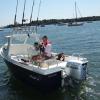
Blimey I was only mucking about with pictures and stuff So the long and short of it is that I saw a picture on a Facebook group. Its the pictured above , It just spiked my interest , NO , I'm not looking for a project , then again it looked OK, she had been fully sorted , new transom, new everything. All done from a professional builder , Gummidge has one (endeavour 3) his is also a 20ft job, she's a big old girl , very stable platform , nice cabin for a occasional night on the water , yep I quite like them but not as much as as Suntrip ( The Hobbit) I did a very stupid thing , when insuring Hobbit I gave its value without much thought, after all , its hardly going to sink in the short time it's on the water , only really insuring it for the liability on the mooring My stupidity reared up again when I put on a Yamaha 40 ( it actually did two trips out before sinking ) ( the old 60 was taken off ) it only took a couple of hours , shame I didn't tell the insurance company about the rise in value , shame I also put on a new VHF, new Sonarphone etc . Shame I also put all my rods, reels , lures , life jackets in the cabin ready for a trip out . If you are sensible you make sure your craft is insured to its true value, So here's the beginning of this story , the insurance ( correctly) paid up for what I had told them the value was . More than sick What now ? Give up ? Dunno , No chance on throwing one penny more than what I got paid out , I'm not a idiot ( ?) but realised it was stupid to try again , I had become totally disheartened. Sod the fishing , boats cost far more than I justify, only went out six times last year AND the weather was crap , Oh the other ugly nasty thing that shall remained kept very quiet ( I'm not a attention or sympathy seeker ) also affected every decision. About time to liven things up on here , it's very quite , so time to get out there in the cold with a few hammers and a stick of mastic . Massive thanks for all the gear etc , I going to set myself a target of 6 months to make sure I get of my ass and do this . -~~~~~~~~~~~~~~~~~~~<<<<<<<<<<<<<<<<<<<<<<<<<<<<<<< Page 1 ; I've just bought a 20ft dory / flyer thing ) looks ok , it's a bit of a project , let's see what happens1 point
-
Cheers Martin, I did see it but forgot !!! Must be an age thing !1 point
-
Don't remember seeing old thread about the Hobbit,, glad to see you have another boat.1 point
-
Bloody Hell Hooky, hope you and all aboard are ok ? Really sorry to hear about this, what caused the boat to go down ? Mick1 point
-
Not yours sunk i hope?1 point
-

Club night
Jim reacted to Raymond Ellerton for an event
LOL can meet for a pint on the 14.01.18 Or indeed any time from now until then1 point -
Club night
Jim reacted to Maverick Martin for an event
Ray that's totally unacceptable 15.01.18 is my birthday and I was hoping for a pint from everyone you sneaked out of that one1 point